Features
Part of Apparel blank guide: fibers, fabric structures, weight, color, seams, fit, and print behavior
Selecting a stable hoodie blank for a multicolor back print case
Three hoodie blanks tested against one 10-inch three-color back print, showing why the cheapest garment lost and what the approval had to freeze.
What to take away
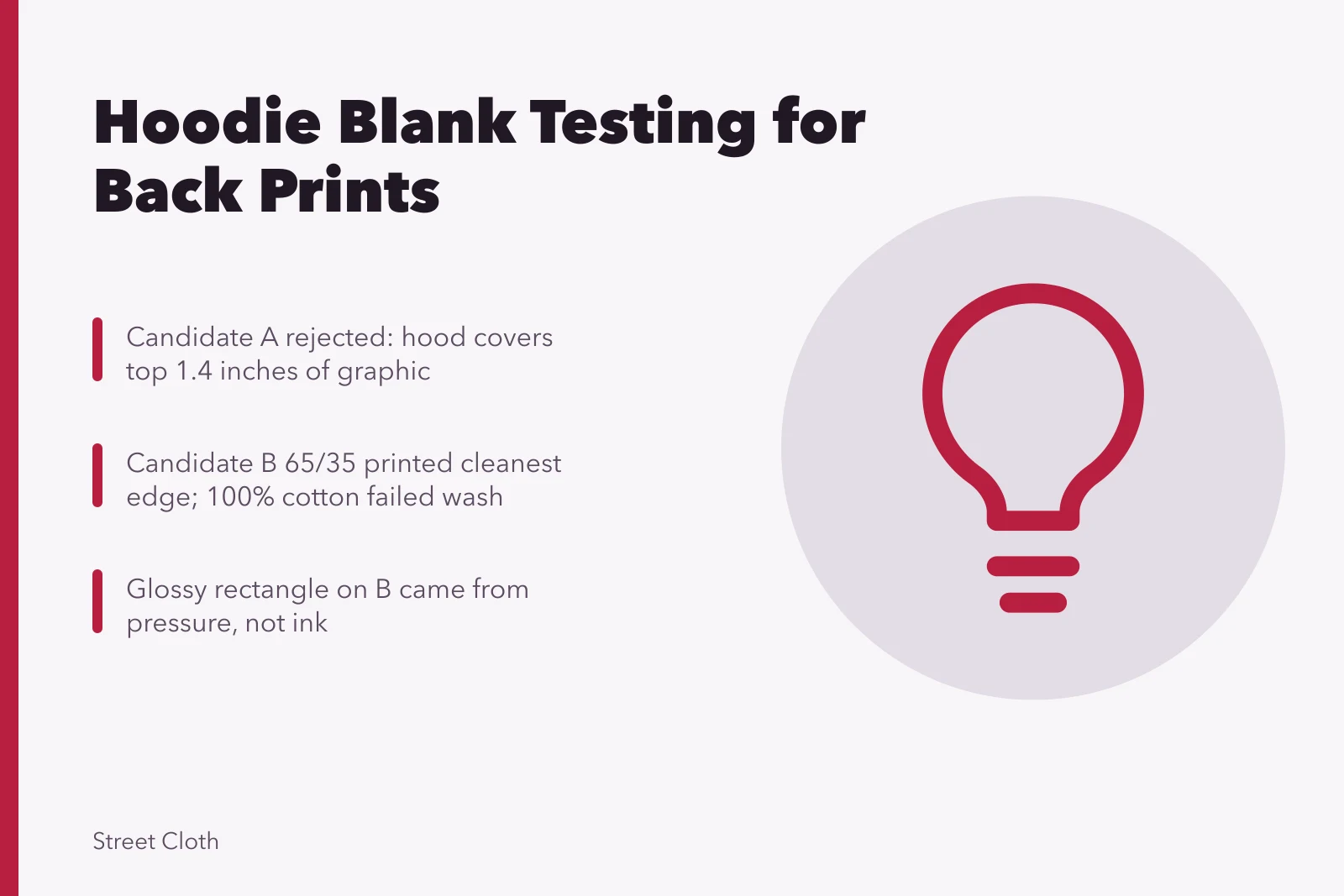
- A blank is qualified against one artwork, not in the abstract. Candidate A failed on hood overlap before any ink was laid down.
- Fiber percentage predicts nothing. Candidate B, the 65/35, printed the cleanest edge; the 100 percent cotton French terry lost the wash gate.
- Test heat alone first. A glossy rectangle on Candidate B came from pressure, not from the ink.
- Price the added screen and cycle time into the order. The cheaper garment won after those costs were counted.
- Sample by class from stock blanks10-ounce 80/20 heavyweights such as Independent Trading Co. IND4000, budget 50/50 fleece such as Gildan 18500, and smooth mid-weight fleece such as Bella+Canvas 3719.
- Freeze the approval to a blank, color, lot, blocker, pressure and cure sequence. A new lot gets rechecked.
A streetwear label needs 72 black pullover hoodies with a 10-inch-wide, three-color screen print on the upper back. The art carries a white underbase, narrow red lines and a pale gray field.
Two conditions drive the hoodie blank choice here. Red garment dye must not bleed into the pale areas, and the hood must not touch the print while the garment hangs. The three samples below came from a seven-blank shortlist.
The costs and results here are a worked example. Substitute your own figures, limits and lot numbers, and verify every sample against your own artwork.
Write the gates before ordering
Acceptance criteria go down on paper first, because a criterion invented after a failure is not a criterion.
Acceptance gates before ordering
- Flat back area carries full graphic
- Hood clears graphic in hanging position
- No seam crosses print boundary
- No lasting gloss or flattening
- Red lines separate, pale areas match
- No color shift after 24-hour hold
- Dimensions stay inside brand limit
Order medium, large and extra-large from one received lot per candidate, and code every unit.
The shortlist: seven hoodie blanks worth sampling
Seven named blanks cover the fiber and weight classes a screen shop can order. Prices are typical US wholesale for black as of 2026, and quantity, color and freight move them.
| Hoodie blank | Fiber and weight | What it does, and who it suits | Typical blank cost |
|---|---|---|---|
| Independent Trading Co. IND4000 Heavyweight Hooded Pullover | 80/20 cotton/poly, 10 oz | Heavy fleece with a deep three-panel hood, which is the placement risk on a high back print | $16 to $19 |
| Comfort Colors 1567 Garment-Dyed Hooded Sweatshirt | 80/20, about 9.5 oz | Pigment-dyed, so pale inks can pick up migrating dye; shade varies by dye lot | $20 to $24 |
| Lane Seven LS14004 Premium Pullover Hoodie | 80/20, about 8.5 oz | Mid-weight premium fleece with a soft hand, common in streetwear runs | $14 to $17 |
| Bella+Canvas 3719 Sponge Fleece Pullover | 52/48 airlume combed ring-spun cotton/poly, 8.5 oz | Smooth face that holds fine lines on a three-color print | $16 to $20 |
| Gildan 18500 Heavy Blend Hooded Sweatshirt | 50/50, 8 oz | Cheapest in the field, boxy body, shallow hood, suits low-placement art | $9 to $13 |
| Champion S700 PowerBlend Hoodie | 50/50, 9 oz | Low-shrink, low-pill finish, retails around $40 | $17 to $22 |
| Stanley/Stella Cruiser | 100 percent organic cotton brushed fleece, 350 gsm | Cotton-heavy loops move in the wash; sold mainly in the EU and UK | $30 and up |
Once the blanks arrive, the label codes three of them A, B and C. The press team then judges the garment instead of the hangtag.
| Candidate | Blank class | Noted risk | Landed blank cost |
|---|---|---|---|
| A | 80/20 cotton-polyester fleece, heavy, 10 oz, generous three-panel hood (Independent Trading Co. IND4000 class) | Hood hangs low; moderate face hair | $18.40 |
| B | 65/35 cotton-polyester fleece, medium-heavy, ring-spun | Dark dye, higher polyester content | $16.90 |
| C | 100 percent cotton French terry, medium, mill-direct | Open face; shrinkage unknown | $19.10 |
Descriptions do not decide anything. Verify the labels, photograph the construction, measure each sample and map where the hood and seams fall.
The Fashion Institute of Technology ran a comparative knit study in which students built several structures from several yarn types and compared how each performed.
Its fiber and fabric study summary links stitch formation, yarn choice and knitting machinery to appearance, mechanical behavior, cost and sourcing.
That is the argument for testing structure rather than ranking blanks by fiber name.
Dry placement removes Candidate A
Candidate A has the width, but its hood covers the top 1.4 inches of the approved graphic when the garment hangs. Dropping the print lower breaks the composition approval and crowds the waistband. Scaling it down loses the size the customer approved.
Record A as rejected for this artwork at this placement. The blank is not defective; it would suit a smaller or lower graphic. Generous-hood heavyweights such as Independent Trading Co.'s IND4000 and Comfort Colors' 1567 belong on that shorter list, not on this order.
Candidates B and C clear the hood and the seams in every sampled size. Templates and measurement photos go into their trial files.
Heat-only trials split the survivors
Unprinted coded samples take the proposed flash and cure exposure. Candidate B shows a faint glossy rectangle at the original pressure. Reducing pressure removes the mark and stays inside the trial range for the equipment and ink system. Candidate C shows nothing.
Neither result approves a print. The next step is a controlled test image carrying the production separations plus registration marks, fine lines, solid fields and a stepped opacity area.
Print trials split appearance from stability
Candidate B lays the smoothest edge and shows the least fabric hair. After cooling, the pale gray field picks up a faint warm cast. A second trial with a compatible blocking underbase holds color through 24 hours but adds hand and one more print step.
Candidate C holds the pale colors with no blocker, but its surface loops soften the narrowest line. Thickening that line slightly keeps the approved look and the revised separation prints clean.
Both then run the same laundering and conditioning sequence. B stays inside the dimensional limit. C loses more body length than allowed, and the back graphic reads slightly compressed.
CottonWorks describes knit approval as a sequence. It starts with yarn and construction choices, then knit-downs and color development. Next comes sample yardage, then testing. Bulk cutting happens after.
Its designing knit textiles lesson notes that fabric performance and garment construction are connected, and names shrinkage, colorfastness and pilling among brand test concerns.
The source covers mill-side fabric development, so treat it as control logic, not as a claim that a blank buyer directs the mill.
Price the finished garment, not the blank
Candidate B costs less undecorated but needs a blocker, an extra screen, more setup and a longer print cycle. Candidate C needs an artwork revision and still fails the dimensional gate. Do not bury that failure in a cost average.
At typical 2026 wholesale, budget 50/50 fleece runs $9 to $13 a blank and premium 80/20 ring-spun runs $14 to $19. Adding a fourth screen to a three-color job usually costs $20 to $35 in screen charges, plus setup time.
Candidate B vs C decision
Placement: both pass
Heat-only: B pass at revised pressure, C pass
Fine detail: B pass, C pass after line change
Candidate B
- Placement
- Pass
- Heat-only appearance
- Pass at revised pressure
- Fine detail
- Pass
- Pale-color hold
- Pass with blocker
- Wash dimensions
- Pass
- Added production work
- Blocker and screen
- Decision
- Approve conditionally
Candidate C
- Placement
- Pass
- Heat-only appearance
- Pass
- Fine detail
- Pass after approved line change
- Pale-color hold
- Pass
- Wash dimensions
- Fail length limit
- Added production work
- Revised separation
- Decision
- Reject for this order
Candidate B wins this order, conditional on the exact blocking underbase, the revised pressure, a tested cure sequence and the received black lot. Price the extra screen and cycle time into the quote before you commit.
Freeze the approval to a lot
The job file keeps the brief, the candidate specs, the sample codes, the measurements and the placement photos. It also keeps the heat trials, the artwork versions, the print settings and the 24-hour inspections. The laundering record, the dimensional math, the cost comparison, the rejected results and the signed reference sample close it out.
Purchasing may not swap in another 65/35 black hoodie without review. A new lot gets identity, shade, measurement, heat, color-hold and wash checks before release. That single condition turns a one-time sample pick into a controlled production decision.
Common questions
Why was Candidate A rejected before any printing?
Its hood covered the approved graphic, and the permitted artwork changes did not resolve the conflict. Printing it would have burned press time without meeting the placement gate, so the team stopped at dry placement.
Why not keep Candidate C and accept more shrinkage?
The brand set the dimensional limit before testing. It could knowingly change the product requirement, but redefining a failure after seeing it is how a bad blank reaches bulk. If the limit moves, retest C against the new limit on fresh samples.
Did the fiber ratio cause Candidate B's color shift?
The trial ties the shift to that candidate and that process, not to fiber alone. Dye, finish and garment color can all contribute, and so can heat, ink and construction. A blocking underbase solved it here, which points at dye migration rather than at the blend.
Does the approval cover another color of Candidate B?
No. The approval names the black color and the received lot. Another color carries different dye and different migration risk, so it needs its own identity, heat, print, color and care checks before release.