Rules
US apparel labeling rules: FTC fiber content, origin and care for graphic shirts
US apparel labeling rules for graphic shirts cover FTC fiber content, country of origin marking, care wording and label placement on neck, seam or hangtag.
What to take away
- US apparel labeling rules for printed shirts come mainly from the FTC under the Textile Fiber Products Identification Act, with CPSC statutes covering flammability.
- Every covered shirt needs fiber content percentages by weight, the manufacturer or marketer's name, and country of origin marking.
- Care instruction wording must match how the garment actually behaves, including the print, not just the blank.
- Labels can sit on the neck, a side seam or a hangtag, but the print area is not a label location.
- Small sellers still have to keep records and label artwork that back up every claim on the shirt.
Which FTC textile rules apply to a printed graphic shirt
The Federal Trade Commission writes and enforces the labeling rules that most printed shirt sellers meet first. The core statute is the Textile Fiber Products Identification Act, which requires fiber content and origin disclosure on textile products sold in the United States.
You can read the underlying text in the FTC's published Statutes | Federal Trade Commission.
A printed graphic shirt is a textile product. The blank is a woven or knit fabric, and the print adds ink, not a separate exemption. If you sell a decorated tee, hoodie or tank to US consumers, the fiber rules apply to you whether you print one shirt or ten thousand.
The FTC also runs rulemaking on textile fiber products rules that set what a label must say. Those proceedings are where wording, order and disclosure details get updated, and they are tracked through the agency's Rulemaking | Federal Trade Commission page.
Three federal bodies touch a printed shirt. The FTC handles fiber content, origin and care claims. The Consumer Product Safety Commission handles flammability and some children's apparel rules. The IRS and state agencies handle tax, not labels. Knowing which body owns which rule keeps you from over-labeling or missing a duty.
Most small brands do not need a lawyer to start. They need the FTC's plain-language guidance for businesses, which explains labeling duties for apparel sellers in ordinary terms. That material lives in the FTC's Business Guidance Resources | Federal Trade Commission collection.
State law can add requirements. California, New York and others have their own rules on some apparel claims, but federal fiber, origin and care rules set the floor nationwide. Build the federal label first, then check the states you ship into.
Fiber content percentages and how blends are stated on a care label
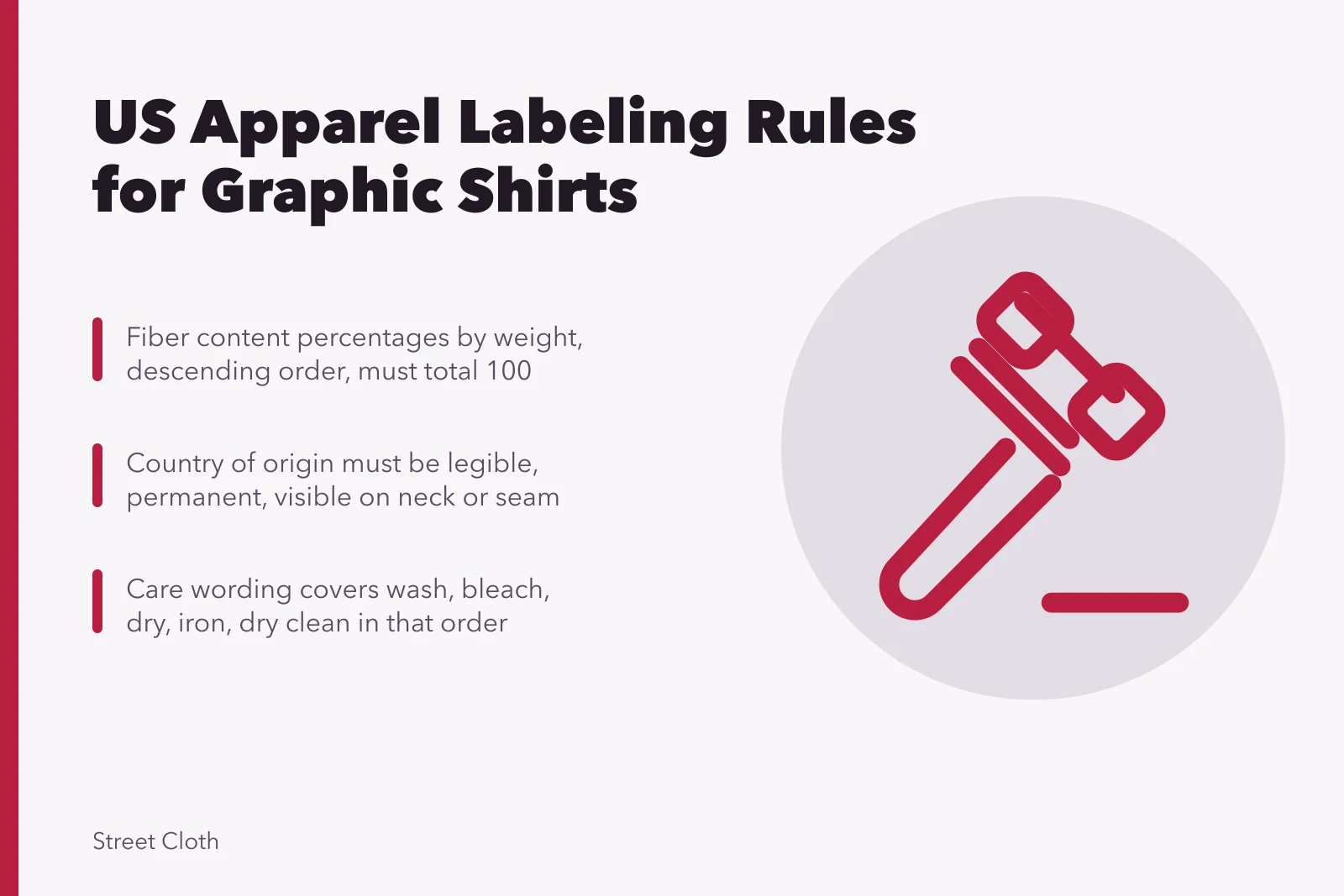
Fiber content must be stated as a percentage by weight of the total fiber in the garment. A 100 percent cotton tee says so. A 60/40 cotton-poly blend says 60 percent cotton and 40 percent polyester, in descending order by weight.
Fiber Content and Care Needs
100% Cotton
- Fiber statement
- 100 percent cotton
- Order by weight
- Single fiber
- Care must allow
- Shrinkage
60/40 Cotton-Poly
- Fiber statement
- 60 cotton, 40 poly
- Order by weight
- Cotton first
- Care must allow
- Scorch risk
With Spandex
- Fiber statement
- Under 5 percent other
- Order by weight
- Spandex last
- Care must allow
- No high dryer heat
Percentages have to add up to 100, with limited tolerance for minor fibers. If a fiber is present at less than 5 percent, it is usually listed as "other fiber" unless it has a functional significance, such as spandex that gives stretch. Do not round in a way that changes the order.
Order matters more than most printers expect. The fiber with the highest weight goes first. If your supplier changes a blank from 50/50 to 60/40, the label changes even though the shirt looks the same.
Blends also drive care wording. Cotton shrinks and takes heat. Polyester holds shape and can scorch. Spandex hates high dryer heat. The fiber list and the care panel have to agree, or the label contradicts itself.
Get the fiber breakdown from the mill or importer, not from a product page. Suppliers issue fiber content statements, and those documents are what you keep. A garment blank checklist helps you capture fiber, dye lot and shrinkage data before the first print run.
| Garment | Typical fiber statement | Care panel must allow for |
|---|---|---|
| Ringspun cotton tee | 100 percent cotton | Shrinkage, hot iron risk |
| Cotton-poly tee | 60 percent cotton, 40 percent polyester | Lower dryer heat |
| Tri-blend tee | Cotton, polyester, rayon percentages | Low heat, gentle cycle |
| Poly performance shirt | 100 percent polyester | No hot iron, no fabric softener |
| Cotton-spandex fitted tee | Cotton with spandex percentage | Cool wash, low dry |
For a printed shirt, the ink adds weight but not fiber. Do not list ink or print as a fiber. The fiber statement describes the fabric, and the care panel covers the decoration.
Country of origin marking for imported and domestic blanks
Country of origin marking tells the buyer where the garment was made. Imported goods must be marked with the country of origin, and the marking has to be legible, permanent and visible to the consumer.
For shirts, the usual place is a neck label or a side seam label. A hangtag alone is often not enough for imported apparel because the tag can be removed. If the shirt is imported, put the origin on a label attached to the garment.
Domestic blanks are different but not exempt. A shirt made in the United States from US materials can be marked "Made in USA." A shirt assembled here from imported fabric generally cannot claim that without qualification. The FTC polices origin claims, and vague wording invites a complaint.
Watch the words "imported" and "assembled." A blank knit overseas and printed in the United States is still an imported textile product for origin purposes. The printing does not move origin to the United States.
Keep the commercial invoice, the entry paperwork and the supplier's origin statement together. When a buyer, marketplace or customs officer asks where the shirt came from, you want one file that answers it. The traceable graphic apparel run guide covers how those records fit with costing and fulfillment.
If you import directly, the marking duty sits with you as the importer of record. If you buy from a US distributor, confirm that the garment already carries the required origin marking before you print.
Care instruction wording: washing, drying, ironing and print-safe language
Care instructions must be accurate and based on a reasonable basis, usually a test or the supplier's recommended care. The wording has to cover regular care: washing, drying, ironing and any bleaching or dry cleaning the garment tolerates.
The order of care symbols or words follows a standard sequence: wash, bleach, dry, iron, dry clean. If you use symbols, they must follow the recognized system. If you use words, use plain ones a customer understands.
Print-safe language is where decorated shirts get tricky. A care panel that says "tumble dry high" may be true for the blank and false for the print. Heat can crack plastisol, dull a soft-hand print or shrink a transfer.
Write the care panel for the finished garment. If the print requires a cooler wash or a lower dryer setting, say so. "Machine wash cold, tumble dry low, do not iron decoration" is a common and defensible panel for screen printed shirts.
Be careful with claims like "will not fade" or "crack proof." Those are durability claims, and they need evidence. The apparel heat-transfer guide helps you tie wash testing to the wording you print on the label.
Test before you commit. Wash a printed sample through the cycle your label describes and check hand, adhesion and color. If the shirt fails, change the label or change the print. The graphic apparel production checklist walks through cure, adhesion and wash behavior.
For children's sleepwear and some other categories, CPSC rules on flammability add labeling duties. General purpose children's shirts are not sleepwear, but the line is not always obvious. The CPSC's Small Business Resources | CPSC.gov page explains compliance help for small firms.
The Flammable Fabrics Act is the CPSC statute behind much garment flammability regulation. Its text and related statutes are listed at Statutes | CPSC.gov. If your shirt could be used as sleepwear, read that before you print a care label.
Where each label goes: neck, side seam, hangtag and print area
Label placement is a practical decision with legal limits. The fiber and origin information has to be attached to the garment, not just handed over at the register.
Label Placement Options
Neck Label
- Carries fiber content
- Yes
- Carries origin
- Yes
- Stays with garment
- Yes
- Common use
- Traditional
Side Seam Label
- Carries fiber content
- Yes
- Carries origin
- Yes
- Stays with garment
- Yes
- Common use
- Tagless soft shirts
Hangtag
- Carries fiber content
- Can
- Carries origin
- Not alone for imports
- Stays with garment
- No, removable
- Common use
- Retail display
The neck label is the traditional spot. It sits inside the back collar and carries brand, size, fiber content and often origin. It is the first place a buyer looks.
A side seam label is common in soft, tagless garments. It carries the same required content and sits in the left side seam, usually near the hem. Side seam labels are popular with print shops because they keep the neck clear.
A hangtag can carry care and origin information, especially for retail display. Hangtags are removable, so do not rely on a hangtag alone for content that must stay with the garment, particularly origin on imports.
The print area is not a label location. Artwork on the chest, back or sleeve does not satisfy fiber, origin or care duties. A printed care panel on the inside of a shirt is unusual and risky because the ink may not survive washing as well as a woven label.
Numbered steps for building a compliant label set:
- Get the fiber content and origin statement from your blank supplier.
- Decide the care panel based on the blank and the print process.
- Choose placementneck label, side seam label or both, plus a hangtag if you want retail detail.
- Draft the label artwork with fiber, origin, care and your brand or RN number.
- Proof the artwork against the supplier documents before the run.
- File the approved artwork and supplier certificates with the order.
A checklist for each style before it goes to press:
- Fiber content percentages match the supplier statement
- Country of origin is on an attached label
- Care wording covers wash, dry, iron and decoration
- Brand name or RN number is present
- Size is marked
- Label placement is confirmed for neck, side seam or hangtag
- Artwork file is saved with the supplier certificate
What the Textile Fiber Products Identification Act requires of small sellers
The Textile Fiber Products Identification Act applies to anyone who manufactures, imports or sells covered textile products in the US. There is no small seller exemption for fiber content and origin disclosure.
The Act requires the fiber content, the name of the manufacturer or the marketer, and the country of origin. It also requires that the information be on a label attached to the product or on a tag or stamp that stays with it.
A registered identification number, the RN, can stand in for the company name. You apply for an RN through the FTC, and it appears on the label instead of your full business name. Many small brands use an RN because it keeps the label clean.
Care labeling is a separate requirement, but it works alongside fiber and origin. The care panel must be there and must be accurate. Missing care information is one of the most common findings in apparel labeling complaints.
Small sellers often assume a marketplace or printer handles compliance. Usually it does not. Marketplaces may ask for label images, and printers print what you send. The duty stays with the seller whose name or RN is on the shirt.
Build labels into your product setup, not into a later fix. The graphic apparel production guide keeps label content, invoices and shipping records in one place so a label question does not stall an order.
Documenting label artwork and supplier certificates in your order file
Every style should have an order file that proves what you claimed and why. The file is your defense if a customer, marketplace or regulator questions a label.
Keep the supplier fiber content statement, the origin statement and any test reports. Keep the approved label artwork with a version number and the date it was approved. Keep a photo of the finished label on a production shirt.
When a blank changes, the file changes. A new mill, a new dye lot or a reformulated blend can shift fiber percentages and care needs. Treat a blank change as a label change until you confirm otherwise.
Store the file where you can find it in a year. Cloud folders named by style number work. Paper binders work. What fails is a label claim with no document behind it.
Match the file to the invoice and the shipment. If a buyer asks for the fiber content of a specific order, you want to pull the exact certificate for that run, not a generic spec sheet.
Review the file when you reorder. A quick check of fiber, origin and care against the current supplier statement takes minutes and prevents a reprint of thousands of mislabeled shirts.