Guides
Graphic apparel production guide: brief, garment, artwork, method, proof, print, and records
Graphic apparel production guide to briefs, garment blanks, artwork, print methods, samples, proofs, production controls, inspection, release, and records.
What to take away
- Freeze a measurable product brief before buying blanks or preparing separations.
- Qualify the garment, decoration method, artwork, ink or transfer system, and care claim as one product.
- A digital mockup approves composition; it does not prove color, scale, hand, cure, or wash durability.
- Approve a physical sample or defined production proof before the full run when risk warrants it.
- Inspect the first acceptable unit, the run at intervals, and the packed order against the same specification.
- Keep records that connect every released garment to its artwork version, blank batch, process settings, checks, and disposition.
Graphic apparel production is a chain of translations. A creative idea becomes a measurable design, the design becomes production data, and that data controls ink, thread, film, heat, pressure, placement, and inspection on a particular garment. Most disputes begin where one translation was assumed instead of approved.
Write the product brief
Give the project a unique order code. Identify the customer or collection, quantity by style, color, and size, decoration locations, target use, price position, delivery window, packing, and approval authority.
Visual language to production fields
Request
- Large back graphic
- Finished width and height
- Soft vintage print
- Method
- Black hoodie
- Supplier
- Exact red
- Named color target
- Ready Friday
- Approved proof date
Production field
- Large back graphic
- Reference datum
- Soft vintage print
- Ink system
- Black hoodie
- Style
- Exact red
- Substrate
- Ready Friday
- Blank availability
Translate visual language into fields:
| Request | Production field |
|---|---|
| "Large back graphic" | Finished width and height, reference datum, placement tolerance |
| "Soft vintage print" | Method, ink system, deposit target, color sample, hand and durability criteria |
| "Black hoodie" | Supplier, style, fiber label, color name, batch, fabric weight, construction |
| "Exact red" | Named color target, substrate, light and instrument or visual approval method |
| "Ready Friday" | Approved proof date, blank availability, production, cure, test, packing, dispatch |
List exclusions. If color varies by garment dye lot, a seam interrupts the print, or a hood can cover part of a back graphic, put that condition in the brief rather than relying on a later explanation.
Qualify the garment before the process
Record brand or supplier style, fiber content, fabric structure, weight, color, size range, seams, pockets, zippers, coatings, water-repellent treatments, and care label. Verify physical dimensions across representative units and batches.
Print behavior can change with fiber, dye, finish, moisture, texture, thickness, stretch, and heat sensitivity. A process that works on a white cotton jersey may show dye migration, press marks, distortion, weak adhesion, or harsh hand on a dark polyester fleece. Test the actual blank and color.
Preserve a sealed reference garment or a complete measurement and photo record. Do not silently substitute a visually similar blank after approval.
Prepare controlled artwork
Store the original and create a production copy with a version number. Record finished dimensions, aspect ratio, vector and raster elements, effective resolution, font status, spot or process colors, underbase, traps, halftones, transparency, stroke limits, and output orientation.
Controlled artwork record
- Original plus versioned production copy
- Finished dimensions and aspect ratio
- Vector and raster elements
- Effective resolution and font status
- Spot or process colors, underbase, traps
- Halftones, transparency, stroke limits
- Output orientation and license scope
Avoid treating screen color as a production standard. Monitor settings, garment color, ink opacity, curing, lighting, and print method all change the result. Use an approved physical color or print reference where color matters.
Confirm that the customer or brand has permission to reproduce the artwork, trademarks, photographs, typefaces, and licensed elements. Keep the approval and license scope with the order.
Select a method through constraints
Screen printing, direct-to-garment, direct-to-film, heat-transfer vinyl, sublimation, embroidery, and patches have different strengths. Select through quantity, garment material, color count, detail, opacity, hand, stretch, durability, personalization, setup, available equipment, and delivery.
Decoration method selection
Method
- Screen printing
- Quantity
- Direct-to-garment
- Detail
- Direct-to-film
- Detail
- Heat-transfer vinyl
- Color count
- Sublimation
- Garment material
- Embroidery
- Detail
- Patches
- Detail
Considerations
- Screen printing
- Color count
- Direct-to-garment
- Garment material
- Direct-to-film
- Stretch
- Heat-transfer vinyl
- Hand
- Sublimation
- Color count
- Embroidery
- Hand
- Patches
- Hand
The method is not a hidden supplier choice when it changes appearance or care. State it in the specification. Then qualify the complete system: artwork preparation, garment, pretreatment, screen or transfer, ink or thread, equipment, settings, cure or press, cleanup, and test.
Separate mockup, sample, and production proof
A mockup shows intended placement and composition. A decorated preproduction sample tests the real build. A first-off or strike-off confirms the setup at production conditions. Name which one is being approved.
Approval should record:
Proof approval record
- Artwork version and output size
- Garment style, color, size, batch
- Process, colors, placement, orientation
- Surface appearance, hand, opacity, detail
- Cure, adhesion, laundering, stretch tests
- Approved deviations and approver
Photograph the approved reference under controlled conditions, but retain the physical sample when practical. A photo alone may not preserve texture, gloss, hand, or exact color.
Control production and inspection
Set up from a signed job traveler. Verify screens, files, transfers, thread, inks, garments, attachments, settings, gauges, and environmental conditions before the first unit. Keep unprinted, in-process, accepted, rejected, and rework goods physically distinct.
Production control and inspection
- Set up from signed job traveler
- Verify screens, files, inks, garments, settings
- Keep goods physically distinct by status
- Approve first conforming unit
- Inspect at risk-based frequency
- Stop, quarantine, diagnose, document
- Resume only after documented correction
NIST's apparel-enterprise report maps activities that include sample production, production scheduling, sewing and finishing, in-process inspection, corrective action, finished-garment grading, quality audit, release, and distribution. The 1993 document concerns broader apparel manufacturing and data interfaces, but its function map for apparel production supports treating control, inspection, correction, and release as connected functions rather than one final glance.
Approve the first conforming unit, then inspect at a frequency based on risk and process stability. Check garment identity, size, placement, color, opacity, registration, detail, contamination, scorching, gloss, hand, cure or adhesion evidence, dimensions, labeling, count, and packing.
Stop the run when the process moves outside its accepted window. Quarantine affected units back to the last known good check. Diagnose and document before resuming.
Release through records
The order file should contain the brief, quote, rights evidence, garment records, artwork versions, method specification, color references, sample and proof approvals, process settings, inspection results, test reports, deviations, rework, rejects, packing count, labels, care basis, shipment, and customer acceptance.
Use revision control. Never replace a failed proof or old file without preserving its identity and disposition. The record should show what changed, who approved it, when it became active, and which units it affected.
Common questions
Is a customer-approved mockup enough to start printing?
Only if the agreement defines it as sufficient and the remaining physical risks are accepted. A mockup does not prove the decorated product's color, hand, cure, adhesion, or durability.
Should every order receive a full wash test?
Testing should follow risk, requirements, evidence, and the qualified process. A new garment, ink, transfer, setting, or supplier may require renewed testing.
Can the shop substitute an equivalent blank?
Not silently. A different blank can change fit, fiber, dye, finish, heat response, print result, labels, care, and cost. Requalify and obtain approval.
What should stop a production run?
Wrong artwork or blank, failed setup, drift beyond tolerance, abnormal heat or equipment behavior, missing traceability, failed cure or adhesion evidence, contamination, or any unapproved deviation.
In this guide
- How to plan a first graphic T-shirt production runPlan a first graphic T-shirt run by freezing the blank, locking artwork rights, approving a physical proof, and logging every setting you change.
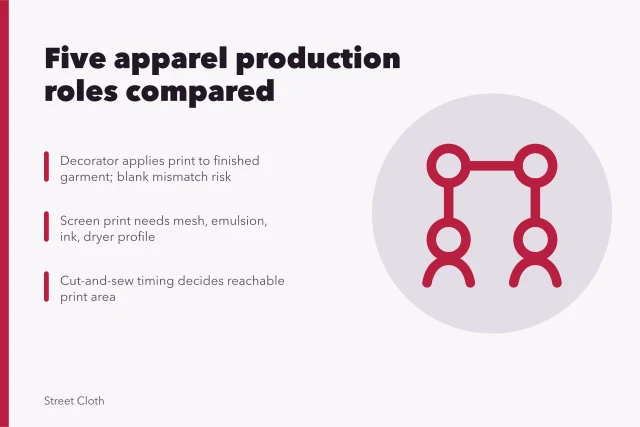
- Decorator, print shop, apparel brand, cut-and-sew factory, and fulfillment provider comparedFive apparel production roles compared by what they own, what they hand off, and which failures land on whose desk when a finished order ships.
- Graphic apparel brief, sample, proof, production, inspection, and release checklistA gate-by-gate graphic apparel checklist covering brief, artwork rights, blanks, fit samples, first-off approval, inspection and final release.
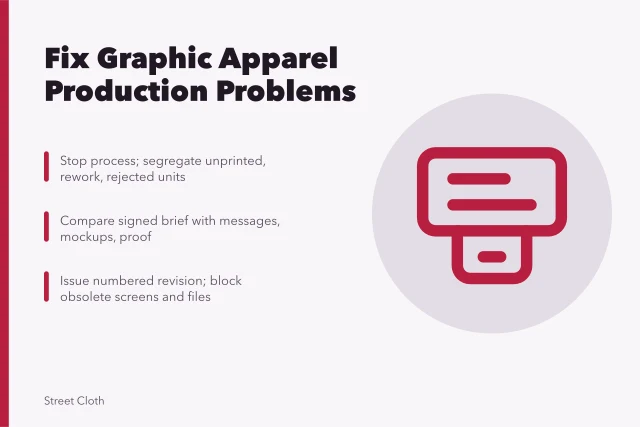
- Graphic apparel production problems: unclear briefs, wrong blanks and print driftGraphic apparel production problems like unclear briefs, wrong blanks and print drift get traced to a cause, contained and stopped from repeating.
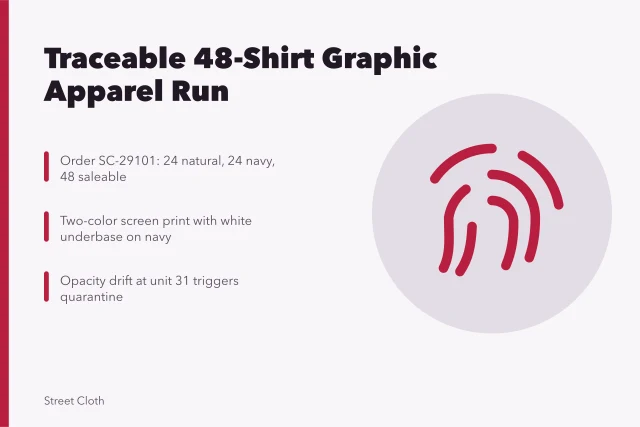
- Planning a traceable 48-shirt graphic apparel run caseTraceable 48-shirt run case with size mix, verified blanks, artwork control, rights approval, proofs, production checks, labels, packing, and reconciliation.