Reviews
Part of Apparel embroidery guide: digitizing, stitch types, thread, needle, backing, hooping, and inspection
Direct embroidery, woven patch, embroidered patch, applique, and printed patch compared
Embroidery and patch methods compared by image detail, thread, fabric, edge, attachment, hand, garment access, quantity, placement, durability, care, and testing.
What to take away
- Direct embroidery sews through the garment; patches are manufactured separately and attached later.
- Woven patches can hold finer thread-built detail than many embroidered patches, but each supplier sets limits.
- Applique uses placed material as part of the image and reduces some solid stitch coverage.
- Printed patches carry tonal detail but add ink, coating, edge, and attachment behavior.
- Attachment method can matter as much as patch construction.
These methods can reproduce the same logo with different surface, hand, depth, edge, reverse side, labor, and garment risk. The useful comparison begins with the final product, not with a digital mockup.
Comparison table
Patch Methods at a Glance
Direct embroidery
- Image construction
- Stitches through garment
- Main advantage
- Integrated raised thread
- Main risk
- Puckering, needle damage
Woven patch
- Image construction
- Interlaced fine yarns
- Main advantage
- Fine lines, flat hand
- Main risk
- Edge, fraying, attachment
Embroidered patch
- Image construction
- Stitches on base
- Main advantage
- Bold texture, controlled base
- Main risk
- Density, border, thickness
Printed patch
- Image construction
- Ink on substrate
- Main advantage
- Gradients, many colors
- Main risk
- Ink durability, coating
Image construction
- Direct embroidery
- Stitches pass through garment and backing
- Woven patch
- Fine yarns form a woven badge surface
- Embroidered patch
- Embroidery builds on separate base material
- Applique
- Cut material is placed and stitched into design
- Printed patch
- Inked image sits on patch substrate
Main advantage
- Direct embroidery
- Integrated raised thread appearance
- Woven patch
- Fine lines and flatter hand
- Embroidered patch
- Bold thread texture and controlled base
- Applique
- Broad color area with fewer fill stitches
- Printed patch
- Gradients, small tonal detail, many colors
Main qualification risk
- Direct embroidery
- Puckering, needle damage, reverse side, access
- Woven patch
- Woven limits, edge, attachment, fraying
- Embroidered patch
- Density, border, thickness, attachment
- Applique
- Cut edge, placement, tack-down, fray, layer shift
- Printed patch
- Ink durability, coating, edge, hand, attachment
Cost and minimum order
Relative unit cost
- Direct embroidery
- Low setup, cost rises with stitch count
- Woven patch
- Mid to high
- Embroidered patch
- Mid
- Applique
- Mid, with fewer fill stitches and more labor steps
- Printed patch
- Lowest at volume, highest at small runs
Typical minimum
- Direct embroidery
- No piece minimum; digitizing fee applies
- Woven patch
- Often 50 to 100 pieces
- Embroidered patch
- Often 50 to 100 pieces
- Applique
- Set by the applique cut and the supplier
- Printed patch
- Often 25 to 50 pieces for digital print
Main cost driver
- Direct embroidery
- Stitch count, garment handling, access
- Woven patch
- Yarn count, size, cut, edge finish
- Embroidered patch
- Stitch count, border, backing, size
- Applique
- Material, cut accuracy, tack-down, trim
- Printed patch
- Ink, base, coating, setup, edge
Treat the tiers as relative, not as quotes. Digitizing is usually a one-off fee set by stitch count and complexity, and cut files, patch dies, and print profiles add their own setup. Size, stitch count, quantity, and turnaround move the number.
Direct embroidery
Direct embroidery integrates the decoration into the garment panel. Needle penetrations, top thread, bobbin thread, backing, and any topping become part of the finished item. It avoids a separate patch edge and attachment operation, but the garment receives the entire stitch load.
Wikipedia's broad embroidery overview describes decoration through needle and thread and surveys machine and material forms. It supports the category distinction, not a production recipe. Commercial stitch files, materials, tensions, speeds, and garment decisions require current equipment and supplier guidance.
Choose direct embroidery when thread texture, integrated construction, and repeatable access fit the garment. Typical uses are a left chest logo on a hoodie or work jacket and a cap front. Typical shop limits set a minimum cap height near 5 mm (0.2 in) and a minimum stroke near 1 mm.
Lightweight knits, coated shells, stretch panels, and areas near seams carry the most risk. The reverse side may need retained backing or a skin-contact cover.
Woven patch
A woven patch forms the image through interlaced yarns rather than embroidery stitches placed on a separate base. Its flatter surface and finer yarn system can preserve small text, tight lines, and detailed shapes at sizes where a satin column would close or distort. Name tapes, cap badges, and fine script marks are common uses.
The tradeoff is a different visual language. Woven badges can look flatter and less dimensional than embroidery. Typical woven work holds lettering down to about 2 to 3 mm and runs 0.8 to 1.5 mm thick.
Edge construction, yarn count, cut method, backing, and attachment determine fray resistance and hand. Ask for a physical sample at final dimensions.
Embroidered patch
An embroidered patch moves the stitch load off the garment and onto a base fabric or other patch substrate. The shop can sew the badge under a controlled hoop and attach it after inspection. This helps with difficult garment access and allows patch inventory to be separated from garment inventory.
The Wikipedia article on the embroidered patch describes a cloth badge formed through thread and commonly attached to clothing. It provides historical and general process context. It does not determine border, backing, stitch density, attachment, or care for a commercial order.
Embroidered patches still need digitizing, thread, needle, backing, border, trimming, and quality control. A merrowed edge, satin border, laser-cut edge, raw edge, or heat-cut edge has different shape and material limits. Thick borders can overwhelm tiny badges.
A typical 3 inch (76 mm) badge with moderate detail runs about 6,000 to 12,000 stitches and finishes 1.5 to 3 mm thick at the border. Think of a jacket-back circle or a sleeve badge.
Applique
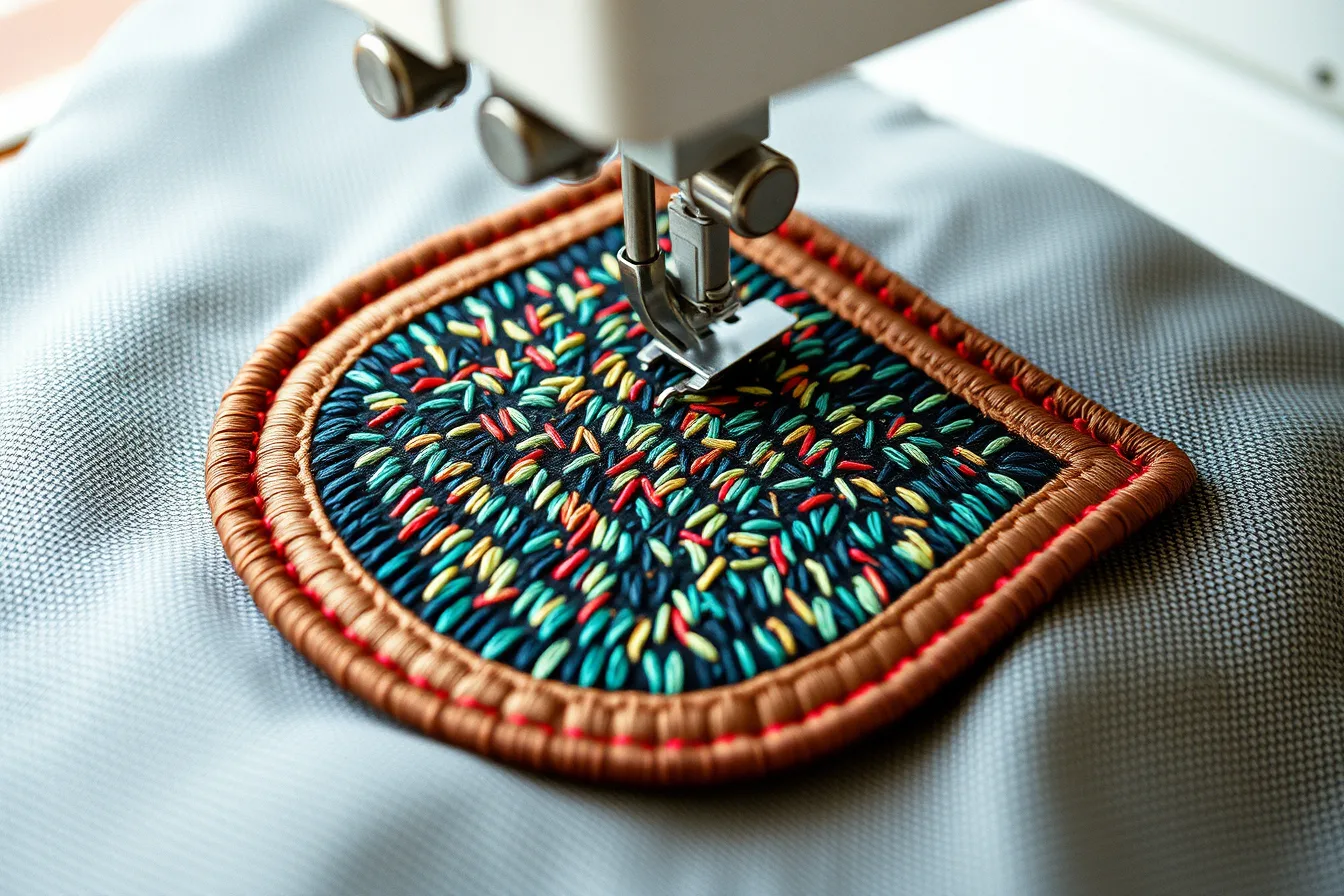
Applique places a cut material inside a stitched construction. A typical machine sequence marks placement, pauses for the applique piece, tacks it down, trims or receives a precut shape, then finishes the edge and details.
The applique material can provide a broad field without thousands of fill stitches. The larger the solid area, the larger the saving. It can also introduce grain, stretch, fraying, cut accuracy, adhesive residue, placement error, raised edges, and layer thickness. Record material face, direction, batch, cut file, tack-down, edge cover, and trim method.
Use applique when the material itself adds color, texture, reflectivity, or reduced stitch load. A varsity letter, a team name across a hoodie chest, and a fleece jacket panel are the usual cases. Do not treat it as an automatic solution for lightweight fabric; the base garment still receives the edge and detail stitches.
Printed patch
A printed patch uses a receptive textile, film, coated fabric, leather-like sheet, or other supported base to carry ink. It can preserve photographs, gradients, fine tonal transitions, and many colors without thread-based separations. A full-color photo patch on a cap front or a denim jacket back is the main case.
Qualify print method, ink, profile, base, coating, cut edge, white layer where used, hand, abrasion, fading, cracking, and care. A glossy printed badge can look very different from a woven or stitched sample even when color values match. Care follows the base and the coating, so it comes from the supplier.
Compare attachment methods
How it works
- Sew-on
- Stitch line through patch and garment
- Heat-activated adhesive
- Press heat and pressure melt a glue layer
- Pressure-sensitive backing
- Cold sticky backing
- Hook-and-loop, snaps, pins
- Hardware holds the patch
Advantage
- Sew-on
- Durable on heavy patches
- Heat-activated adhesive
- Fast, clean face
- Pressure-sensitive backing
- Repositionable and temporary
- Hook-and-loop, snaps, pins
- Removable or swappable
Main risk
- Sew-on
- Needle holes, puckering, labor
- Heat-activated adhesive
- Scorch, shine, adhesive spread, finish limits
- Pressure-sensitive backing
- Weak hold, residue, restricted use
- Hook-and-loop, snaps, pins
- Bulk, snag, loss, hardware wear
A strong patch with weak attachment is a failed product. Care labels on stitched patches commonly call for a 30 C (86 F) wash inside out. Heat-applied patches replace that with a press setting near 150 to 160 C (300 to 320 F) for 10 to 20 seconds at medium pressure.
Run a final selection trial
Order or make candidates at the approved size. Attach them to the exact garment and location. Compare:
- smallest text, line, gap, counters, and color boundaries;
- color, sheen, thread direction, print tone, and surface depth;
- edge, thickness, hand, stretch, reverse side, and seam interaction;
- care, abrasion, flex, attachment, and dimensional change;
- setup, sample, unit, reject, and inventory cost.
Release a method only with the named design, patch construction, materials, edge, backing, attachment, garment, settings, tests, and approved sample.
Common questions
Is a woven patch the same as an embroidered patch?
No. A woven patch forms its image through woven yarns; an embroidered patch builds stitches on a separate base.
Does a patch prevent garment puckering?
It moves most image stitches off the garment, but attachment stitching or heat can still pucker, mark, shrink, or distort the garment.
Can applique replace a solid fill?
Often, but edge, placement, tack-down, fray, layer, and material behavior must be designed and tested.
Which attachment is most durable?
There is no universal winner. Patch base, edge, garment, adhesive or stitch, application, use, and care determine durability.