Features
Part of Digital apparel printing guide: DTG, DTF, pretreatment, white ink, transfer, cure, and maintenance
Choosing DTG or DTF for a short mixed-garment launch case
DTG or DTF selection case for a short mixed-garment launch, using artwork, fabric, placement, hand, schedule, sample tests, costing, approval, and records.
What to take away
- Split a mixed launch into qualified product families before selecting one decoration method.
- Compare the complete DTG and DTF build on the real garments, not printer specifications alone.
- Use risk samples that expose dark color, texture, seams, fine detail, broad coverage, and heat response.
- Judge cold appearance, hand, stretch, laundering, dimensions, throughput, and total expected cost.
- A split-method plan can be stronger than forcing one process across every item.
- Preserve the assumptions and triggers that could change the decision.
This fictional case shows a decision method. It does not prescribe printer, ink, pretreatment, film, adhesive, powder, press, temperature, pressure, dwell, peel, or care settings. Those values belong to the current named system and a qualified trial.
The launch brief
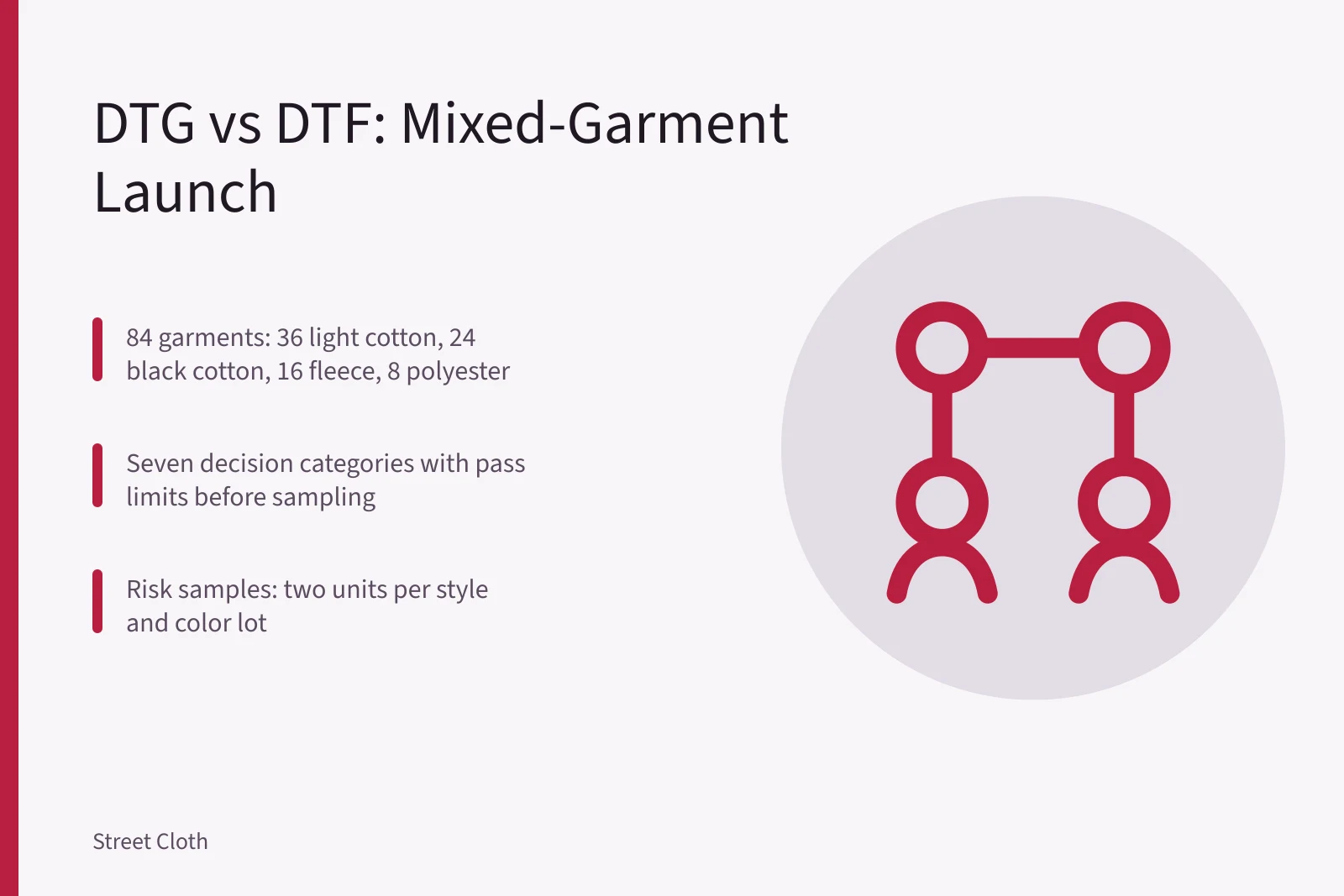
A small label planned 84 garments around one illustrated chest graphic:
Launch brief by garment
Light T-shirt
- Quantity
- 36
- Material
- Light cotton
- Main risk
- Tonal transitions
Heavy T-shirt
- Quantity
- 24
- Material
- Black cotton
- Main risk
- White foundation
Hoodie
- Quantity
- 16
- Material
- Dark fleece
- Main risk
- Texture and seams
Performance shirt
- Quantity
- 8
- Material
- Light polyester
- Main risk
- Heat and dye
| Product | Quantity | Color and material | Main risk |
|---|---|---|---|
| Lightweight T-shirt | 36 | Light cotton | Fine tonal transitions and shirt show-through |
| Heavy T-shirt | 24 | Black cotton | White foundation, broad dark area, and hand |
| Pullover hoodie | 16 | Dark cotton-rich fleece | Texture, lint, seams, thickness, and heat |
| Performance shirt | 8 | Light polyester | Heat response, dye movement, and method compatibility |
The illustration had thin lettering, a soft shadow, six visible colors, and a broad dark shape. The customer wanted a similar visual identity across products but accepted small, documented differences in hand and surface character. The first delivery was due in nine working days, followed by uncertain replenishment.
Define the decision before sampling
The shop rejected a one-number comparison such as cost per print. It wrote seven decision categories:
Seven decision categories
- Artwork fidelity and white alignment
- Garment compatibility and damage
- Finished hand, edge, stretch
- Wash and dry result
- Setup, time, reject allowance
- Inventory flexibility and repeat risk
- Records, maintenance, skill, schedule
Each category had a pass limit. A method that failed garment safety or wash performance could not win through lower cost.
Build the risk sample set
The team selected two units from every garment style and color lot, plus spares. One garment from each group stayed unprocessed. The print file, dimensions, location, RIP, profiles, and test target were frozen.
Risk sample build
- Select two units per style and lot
- Keep one unprocessed control
- Freeze file, RIP, profiles, target
- Run DTG and DTF trials
- Blind-code every sample
- Record labor and machine time
DTG trials used the approved treatment and direct-print workflow for each compatible garment. DTF trials used the named film, ink, adhesive preparation, storage window, press, peel, and finishing sequence. Every sample received a blind code. Operators recorded labor and machine time without changing settings to favor a preferred method.
The light polyester shirt was not assumed to fit either route. The team first checked current equipment and consumable requirements, then ran a separate heat and color-movement trial. If neither build passed, the correct outcome would be a different garment or process.
Inspect the material structure
The review panel distinguished color loss from film or adhesive failure. Pigment-based textile ink systems commonly depend on a binder film to hold pigment at the textile surface.
Cold sample inspection points
- Placement and dimensions
- Gradients and small type
- White edges and dark coverage
- Hand, flex, surface tack
- Garment shine, scorching, distortion
An NC State thesis on aqueous pigment inkjet ink formulation discusses binder-film formation and evaluates wash and rub fastness. It supports testing the finished ink-and-binder system, but does not predict the performance of this fictional job or any commercial DTG or DTF product.
The panel inspected each cold sample under fixed light, then checked placement, dimensions, gradients, small type, white edges, dark coverage, hand, flex, surface tack, garment shine, scorching, and distortion. One specimen from each approved candidate entered the written wash and dry sequence. The matching specimen stayed unwashed for comparison.
Trial results
The fictional results were deliberately mixed:
Trial results by garment
DTG
- Light cotton
- Preferred hand
- Black heavy
- More printer time
- Fleece
- Lint in detail
- Polyester
- Out of range
DTF
- Light cotton
- Edge felt
- Black heavy
- Staged inventory
- Fleece
- Seam contact fixed
- Polyester
- Color movement
- On light cotton, DTG held the soft shadow and produced the preferred hand. DTF passed appearance but its edge could be felt across the broad shape.
- On black heavy cotton, both methods passed color and wash limits. DTG needed more direct printer time; DTF added transfer preparation and pressing but supported staged transfer inventory.
- On fleece, the first DTG test showed surface texture and lint in fine details. The DTF test held detail but showed uneven contact near a seam. A smaller platen and revised location produced a passing DTF sample without changing the art.
- On polyester, the first DTF press trial showed unacceptable color movement. DTG was outside the shop's qualified material range. The team changed the garment rather than masking the failure.
The garment substitution was approved as a product change, not hidden as a production adjustment.
Test readability and use, not decoration alone
The illustration had no code, but the team included a small line-and-square target to expose edge growth after care. This reflected a wider lesson from Kaunas University of Technology research comparing long-term QR-code readability on decorated polyester.
Readability after care
Before care
- Fine lettering
- Intact strokes
- Line-square target
- Sharp edges
- Photo record
- Fixed scale
After care
- Fine lettering
- Check gaps
- Line-square target
- Edge growth
- Photo record
- Fixed scale
That 2026 thesis evaluated sublimation, heat transfer, and embroidery and found that method and code size affected the tested readability over laundering. It does not rank DTG against DTF, but it supports testing whether decoration still performs its intended visual or machine-readable job after use.
For the launch art, the fine lettering remained a human-read requirement. The team photographed it at a fixed scale before and after care and recorded any filled gaps or broken strokes.
Cost the expected order
The estimate included artwork and RIP time, treatment, ink, film, adhesive, press sheets, labor, equipment occupation, maintenance, setup samples, test garments, expected rejects, packing, and rework. It also included the cost of holding finished garments versus holding unapplied transfers.
The numbers did not support one universal winner. DTG had the best expected result for the 36 light cotton shirts. DTF was chosen for the approved black heavy shirts and revised hoodie placement because it met the finish limits and reduced direct printer occupation. The replacement performance style received its own qualified DTF build.
Release the split plan
The production record tied each product to one method and configuration. It included garment and lot, artwork revision, output dimensions, RIP, consumables, equipment, treatment or transfer controls, heat records, first-off approval, wash results, inspection interval, quantity, and retained sample.
The decision also named review triggers: garment or consumable substitution, new lot outside the represented range, artwork coverage change, equipment or RIP change, missed maintenance, repeat-order age beyond the approved window, or a failed in-process check.
The case ended with three qualified product routes, not a slogan about DTG or DTF. That outcome protected the graphic, garment, schedule, and evidence trail.
Common questions
Why not use DTF on every garment for consistency?
Consistency means meeting defined results, not forcing one material build. Hand, heat response, edge, color, and cost can differ by garment.
Why was the polyester style changed?
The tested candidate failed the written color-movement limit, and the shop lacked another qualified route within the schedule.
Should the cheapest passing sample always win?
No. Compare expected total cost, capacity, reorders, rejects, inventory, maintenance, tests, and risk alongside the finished result.
Can the approval cover a future garment lot?
Only if the qualification plan defines that range and incoming checks confirm it. A material change may require a focused requalification.