Features
Is street style really about the clothes, or something else entirely?
Street style has three parties and three motives: arranged versus candid photographs, the permission question, and the commercial layer nobody labels.
Street style is the only fashion photography that claims not to be photography. The premise is that someone was walking along and happened to be photographed. Sometimes that is exactly what happened. Often the walk, the route, the timing and the clothes were all decided in advance, and the only genuinely spontaneous thing in the frame is the weather.
Neither version is a scandal. But they are different pictures with different uses, and telling them apart is the whole skill of reading this category.
What to take away
- A street photograph is made by three parties with different interests: the person in it, the photographer, and whoever pays to publish it.
- The clothes are solving a different problem from event dressing, because the subject is moving, in daylight, outdoors, and unposed.
- Whether someone can be photographed and how the image may then be used are two separate questions, and the second is where the rules actually sit.
Three parties, three motives
The photographer needs frames that sell. That means a recognizable subject, a clean background, good light, and something in the outfit distinctive enough to be worth a caption. They work fast, in crowds, usually outside a venue at a predictable hour.
The subject may want the picture, may tolerate it, or may not want it at all. When they want it, the outfit is a decision made for this specific hour. The walk between a car and a door is the entire performance.
When they do not, the same lens is an intrusion, and the same photograph is a different thing.
The publisher wants images cleared for use, cheaply, with names attached. The market for the picture is what determines whether it gets taken at all, which is why coverage clusters in a handful of streets on a handful of weeks and thins out everywhere else.
Those three motives explain almost every pattern in the genre.
The same corner recurs, pictures arrive in a burst, and an outfit that attracts nothing on an ordinary day attracts a bank of lenses in a particular week.
Arranged, semi-arranged, and genuinely candid
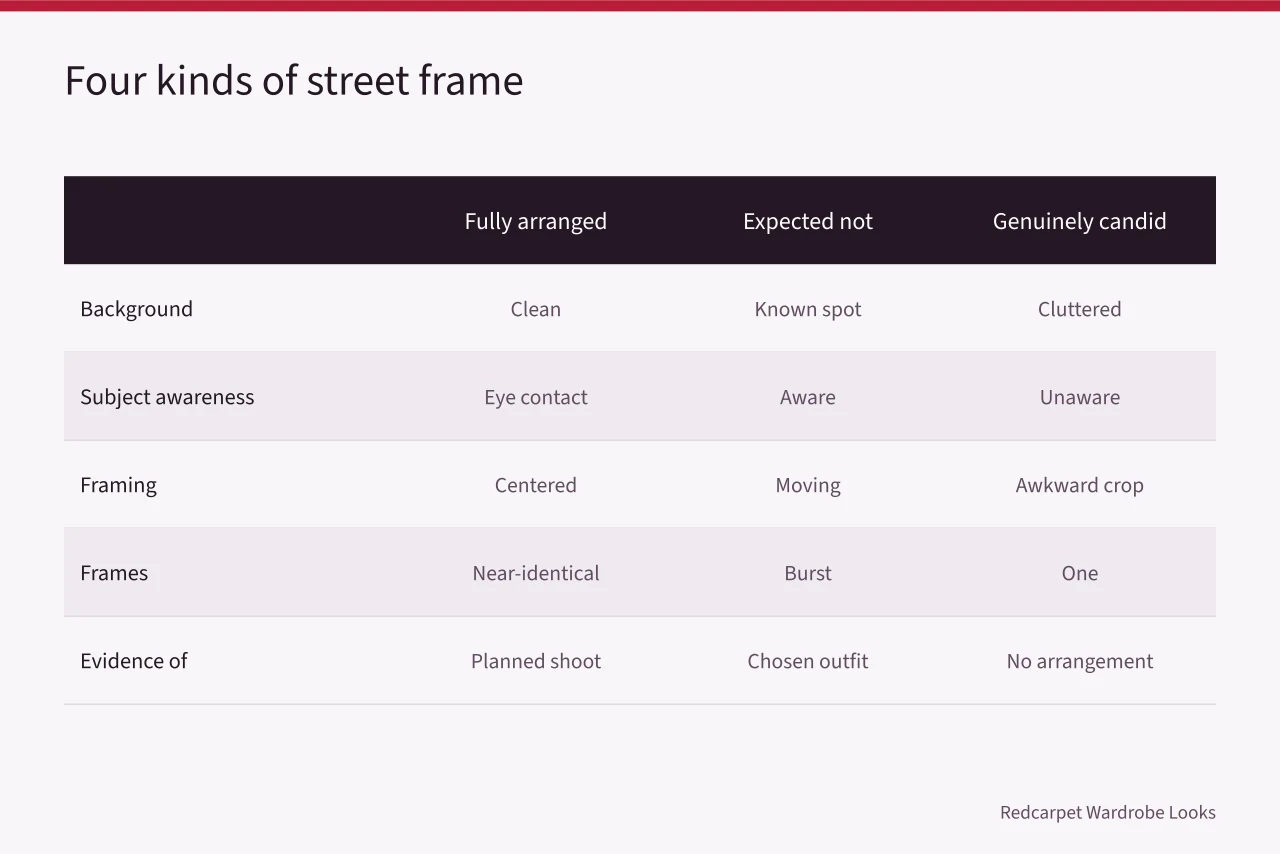
| Kind of frame | How you can tell | What it is evidence of |
|---|---|---|
| Fully arranged | Clean background, subject centered, eye contact, several near-identical frames | A planned shoot dressed as a street picture |
| Expected but not staged | Subject aware, moving, photographers massed at a known spot | The outfit was chosen for this, the moment was not |
| Genuinely candid | Awkward crop, movement blur, background clutter, unflattering timing | Somebody was photographed without arranging it |
| Long lens, private moment | Distance compression, obstruction in the frame, no awareness | Something closer to paparazzi practice than to fashion coverage |
The useful habit is to notice which row you are looking at before drawing any conclusion from the image. A caption reading "spotted" tells you nothing, because it is applied to all four.
The clothes are answering a different question
Event dressing solves for a static pose under flash, as the material on red carpet fashion sets out. Street dressing solves for the opposite conditions, and the garments that succeed are built differently.
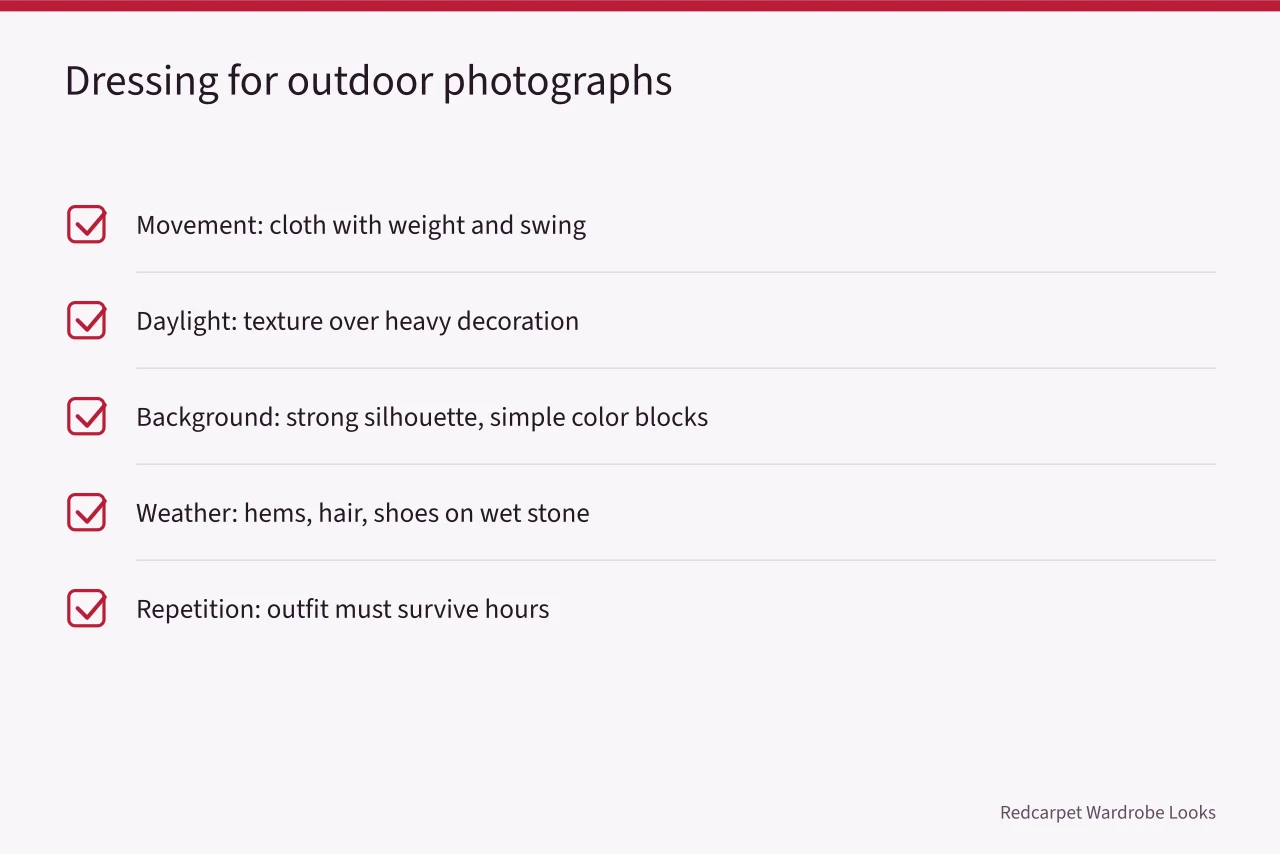
The practical version for anyone dressing for a photograph outdoors: pick a shape that reads at distance, keep the surface simple, and make sure it looks right in motion rather than only when standing.
The permission question, in two parts
People conflate two separate things, and the confusion runs through most arguments about this genre.
The first question is whether a photograph may be taken. In many public places, generally yes, subject to local law and to where exactly you are standing, because a street is not a private space. This varies by country and it varies by the specific location, so the general answer is a starting point rather than an answer.
The second question is what may be done with the image afterwards. A different body of rules applies, often grouped as personality rights.
Those rules distinguish sharply between uses. Editorial publication is treated one way. Advertising with someone's image is treated far more strictly, and consent is normally required. Being lawfully photographed on a street does not imply consent to appear in an ad.
Two practical consequences follow. If you are photographing, the release you need depends on the use you intend, not on where you were standing. If you are photographed, the meaningful question to ask is where the picture will run, because that is what determines what your position is.
The commercial layer nobody labels
Some of what circulates as street style is paid, and the payment is rarely visible in the picture. An outfit may be lent on the condition it appears. A person may be engaged to be somewhere, wearing something, at an hour when photographers are present. An image may be licensed by the party who supplied the clothes.
Nothing is wrong with any of that if it is disclosed where required, but disclosure rules differ by country and by platform.
What matters for a reader is not treating the resulting picture as evidence of an independent choice. When a photograph works as an advertisement, the interesting information is the arrangement, not the taste.
The tell is usually consistency rather than any single frame. One appearance is a choice. The same item appearing on many people in one week, in the same city, is a campaign.
Using the genre well
- Read street photographs for construction and proportion rather than for endorsement. A silhouette that works on a moving body in daylight is a genuinely useful reference.
- Ignore the caption's claim about what was chosen and look at what the garment does.
- Notice the light and the hour before you decide something looks good. Half of what reads as a great outfit is a low sun.
- If you are photographed and would rather not be, say so plainly on the spot. It is not a legal argument, it is a request, and most working photographers respond to a direct one.
- If you are photographing, ask before publishing anything that identifies a private individual who did not expect to be there.
Common questions
Is street style photography just advertising now?
Some of it is, some of it is not, and the two are printed side by side without labels. Judge each image by what it shows rather than by the genre, and treat a run of coordinated appearances as a stronger signal than any single frame.
Can I be photographed in public without being asked?
In many places, yes, within limits that depend on where you are and what country you are in. Whether the resulting picture can then be used to sell something is a separate question with a much stricter answer. The two get argued as though they were one.
Why does the same outfit look better in these pictures than in a mirror?
Distance, lens and light. A photograph taken from several meters away compresses proportion, and outdoor light models the shape of a garment in a way a bathroom mirror does not. It is a fair test of silhouette and a poor test of detail.
What should I take from street style if I am dressing for an ordinary day?
Shape at distance, and fabric that behaves while you move. Those two carry over completely. Almost everything else in the frame belongs to the hour, the street and the photographer.