Maintenance
Part of Graphic apparel quality guide: appearance, placement, cure, adhesion, stretch, laundering, and care
Print placement, color, hand, cure, adhesion, wash, dimensions, care, and release checklist
Apparel print release checklist for product identity, placement, color, hand, cure, adhesion, wash results, dimensions, care basis, defects, records, and approval.
What to take away
- Attach every result to a product, lot, artwork revision, decoration system, and coded specimen.
- Check the cold, relaxed garment against written limits and an approved reference.
- Keep visual, process, adhesion, dimensional, and laundering evidence separate.
- Base care instructions on the complete decorated product and its actual market.
- Quarantine failures before rework can destroy evidence or mix rejected units with good stock.
- Release requires a named approver, quantities, exceptions, and retained records.
Use this checklist as a production control, not as a substitute for current technical instructions, test methods, safety information, a contract, or law.
Job identity and scope
- Job number, customer, product, quantity, and due date recorded.
- Garment supplier, style, color, size range, fiber label, and lot recorded.
- Artwork file, revision, dimensions, location, colors, and approval recorded.
- Decoration method, consumables, equipment, settings, and operator identified.
- Intended use, care route, sales market, claims, and acceptance authority stated.
- Tests, samples, intervals, limits, stop rules, and deviations set before production.
References and specimens
- Approved decorated reference or controlled image and measurement record available.
- Undecorated control retained when garment change matters.
- Unwashed decorated control retained for care comparisons.
- First-off and test garments carry unique codes.
- Samples represent relevant sizes, colors, lots, print zones, and difficult deposits.
- Failed specimens are protected from repressing, cleaning, trimming, or further washing.
Cold appearance and placement
- Required cooling or relaxation time completed.
- Inspection light, distance, background, and reference follow the written method.
- Orientation, location, width, height, and rotation meet limits.
- Color appearance, opacity, coverage, and registration pass.
- Small type, lines, counters, gradients, halftones, and edges remain complete.
- No unapproved stain, adhesive, gloss, scorch, press line, or surface damage appears.
- Seams, rib, pockets, zippers, labels, and drawcords are undamaged.
Hand and process evidence
- Thickness, stiffness, tack, roughness, drape, and edge feel match approval.
- Front and reverse surfaces are checked for strike-through, residue, or backing.
- Ink, film, adhesive, pretreatment, thread, or patch identities and lots match approval.
- Temperature, dwell, speed, pressure, passes, and peel condition are recorded as applicable.
- Measurement tools, locations, timing, and calibration status are identified.
- Thick, thin, edge, and seam-adjacent areas receive the required check.
- A display set point is not the only evidence of the garment's process condition.
Adhesion, stretch, and rubbing
- Adhesion method names sample age, condition, direction, tool, and pass limit.
- Stretch screen specifies direction, extension, hold, repetitions, recovery, and judgment.
- Rubbing check specifies dry or wet condition, material, path, repetitions, and scale.
- Cracks, splits, edge lift, whitening, color transfer, and recovery are recorded separately.
- An internal screen is not called a standard test unless every current requirement is met.
Laundering and dimensions
- Washer, cycle, load, detergent, additives, water, temperature, and count recorded.
- Dryer or line-dry method, setting, load, end point, and cool-down recorded.
- Conditioning time before each inspection is fixed.
- Garment and graphic measurement points, tool, and units are consistent.
- Color, staining, cracks, peeling, abrasion, tack, and detail are compared with the control.
- Shrinkage or growth is separated from skew, twist, puckering, and local distortion.
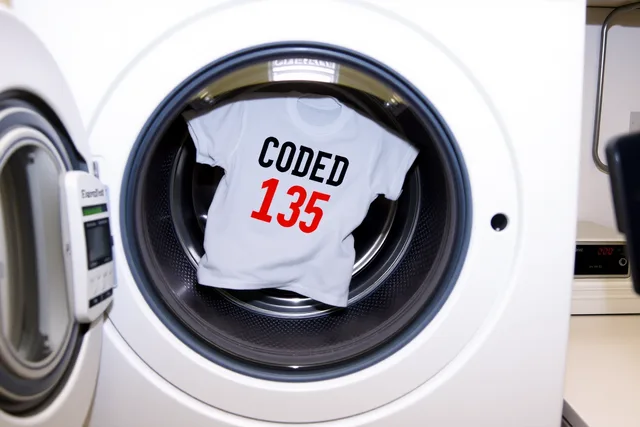
AATCC's summary for TM135 fabric dimensional change identifies length and width change after home-laundering procedures and lists controlled wash and drying options. It supports recording care conditions and directional measurements. It does not define limits for a finished printed garment, and its stated scope is fabrics.
Care and product information
- Care wording matches the tested complete product, including decoration and trim.
- Instructions are reviewed for the country and product category where the item will be sold.
- Warnings identify an assumed procedure that would cause harm when required.
- Description does not overstate durability, colorfastness, shrink resistance, or test equivalence.
- Evidence and approval for every material performance claim are stored.
Review the complete care route against each component. Garment body, rib, drawcord, zipper, patch, thread, print, adhesive, and trim react differently to water, heat, bleach, ironing, and dry cleaning.
Record evidence covering the assembled product. If a normally assumed procedure would damage a component, route the issue to the person responsible for the market-specific warning. Do not create a broad care claim from a blank supplier sheet or a decoration supplier test alone.
Keep proposed label wording, supporting samples, test records, technical literature in one traceable file. Dated approvals and later revisions.
If production swaps garment, ink, transfer, thread, trim outside qualified range, hold the claim until new build has reasonable basis, and do same for any process outside qualified range.
Customer instructions and web product copy should match the label, not promise a harsher care route.
For covered U.S. products, the FTC's apparel and labeling overview states that the Care Labeling Rule requires manufacturers and importers to provide cleaning instructions. The page also summarizes other label topics. Confirm current rule text, coverage, role, and product facts rather than treating this checklist as legal advice.
Nonconformity and release
- Failed interval and affected production range identified.
- Related units placed on hold and physically separated.
- Defect location, extent, photographs, measurements, and identity preserved.
- Cause statement distinguishes evidence from hypotheses.
- Rework is qualified and does not conceal damage.
- Produced, accepted, rejected, reworked, sampled, and shipped quantities reconcile.
- Approved deviations identify scope, reason, risk, authority, and date.
- Retention period and record location are assigned.
- Named person signs and dates final release.
Common questions
Must every box be checked for every job?
Define which checks apply before production. Mark exclusions with a reason rather than silently skipping them.
Can a supplier wash result cover a shop's decorated garment?
It can inform selection, but it does not automatically qualify the shop's complete decoration and care statement.
Who can approve a deviation?
The contract or quality system should name that authority before production begins.
How long should records be kept?
Set retention from legal, contract, claim, complaint, traceability, and business needs for the actual market.